


This page may contain affiliate links. If you purchase something through one of the links, we may receive a commission at no extra charge to you.
How to Use this Mythical Creature Size Comparison Generator
The tool is actually quite simple to use. You just need to pick a mythical creature/monster (e.g. Ammit or Fenrir) from the dropdown list and add it to the chart for 2D size comparison. You can remove a figure from the chart using the ‘Remove’ tab and also hide the names of all figures using the checkbox that’s below the button.
Please note also you can drag any figure to the left or right of others in case you want to change their positions.
With regards to the chart limits, there is a maximum number of 5 figures that can be added.
In order to get the best visual results for comparing the sizes of legendary creatures, try to do the following:
- Access the tool from a computer or large tablet if possible
- When using a mobile device, make the view horizontal (i.e. landscape orientation)
What Creatures or Monsters are Available Inside the Tool
The tool will allow you to compare the size of 78 different mythical creatures along with a human figure.
All monster images used are basically colorful illustrations. And they seem to have been drawn pretty accurately.
Please note that the images are based on the common mythical descriptions rather than the modern or pop culture interpretations.
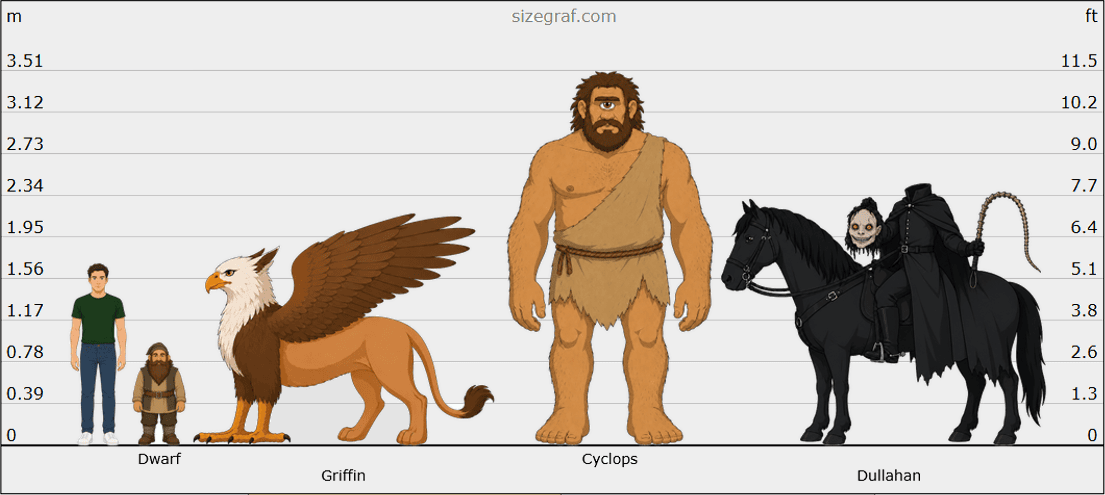
The list includes all kinds of popular mythical creatures. For example, there are legendary birds (Thunderbird), dragons (Fafnir), horses (Unicorn), hybrids (Centaur), giants (Cyclops), sea monsters (Champ), serpents (Basilisk), small humanoids (Fairy), and undeads (Dullahan).
The creatures come from all sorts of mythology origins. But the majority are part of the African, Bestiary, Greek, British, Japanese (Yōkai), Norse, North American, or Scottish mythology. Of those, Greek and Japanese folklore have the highest number of legendary creatures.
Methodology for Estimating the Creatures’ Size
As all mythical creatures are obviously not real, there is no measured size data out there for them (unlike real-world animals).
So, we had to find a way to accurately estimate the size of those creatures. There are several methods we relied on and they all involve the mythical descriptions. They’re as follows, ordered by priority and including one example for each:
- Direct size number – Chupacabra is said to be approximately 3 to 4 feet high.
- Textual size expression – Pixie is described as tiny elflike spirit, short of stature, childlike, and small person (which supports a body height of around 30-50 cm).
- Physical body anatomy – Abada is the size of a small donkey (which indicates a shoulder height of approximately 33-34 inches).
- Indirect size clue – Thunderbird is described as a whale-carrying bird (which results in an estimated creature length of about 12-13 meters).
Please note that we never utilized any modern size data (including movies and videogames), only the traditional mythical descriptions were used. The vast majority of those descriptions came from Wikipedia, Britannica, Theoi, and A Book of Creatures.
So, don’t get surprised if you see your favorite monster being too small here compared to what you already saw in a movie or videogame (Basilisk is a great example of this).
Conclusion
Whether you want to compare the size of various mythical creatures or the size of a specific monster to a human, this accurate online tool will help you out. You just need to choose and add the desired figures to the chart.
It’s worth mentioning the chart axis shows the height measurement in both metric (i.e. centimeters or meters) and imperial units (i.e. feet and inches). So, you won’t need to worry about unit conversion.
Feel free to let us know if you find any height that’s inaccurate or if you would like to see a certain creature/monster added to the list.
